Robert has a lot of stuff up his sleeve for connecting bloggers around the smallweb. After an amazing Junited 2026, now it’s time for JulyReply 2026!
I really enjoyed participating in Junited. Thanks to that, I connected with a few bloggers, one of whom was Imperfect. Imperfect inspired me to write reply posts, but I was reluctant until now. What’s a better excuse than JulyReply to start doing it?
Berkeley Mono: - I don’t feel rich enough to spend $75 on a font even though it looks stunning.
F*CKSignups: A curated collection of open-source tools you can use instantly in your browser. no accounts, no emails, no tracking.
Cara: A social media and portfolio-sharing platform for artists and art enthusiasts.
diffshub: View code changes from any public GitHub diff—PRs, comparisons, commits, diffs, and patches—with a super-freaking-fast, beautiful, and virtualized interface.
Writing this on a Beyoğlu day under siege again, sigh. The whole neighborhood is locked down just because some people want to celebrate who they are…
We started packing today and I’ll be writing next week’s update in our new apartment. Even though I don’t feel excited about leaving our neighborhood, I’m excited to leave this apartment and finally be done with this whole moving thing.
I finished reading The Shadow of the Torturer. Although I wasn’t hooked by it immediately, it turned out to be a great read. I’ll definitely continue the New Sun series, but I want to finish The Time Regulation Institute, which I’ve been reading since January!
I started reading To Have or to Be? by Erich Fromm for the upcoming IndieWeb Book Club. Having read his On Disobedience and Escape from Freedom, I started the book with a positive bias, but after finishing 1/3 of it, I’ve got nothing good to say (yet). I don’t want to go into details right now before finishing the book, and I’ll write a review for the book club anyway.
We watched two movies: Fargo (1996) and The Ugly Stepsister (2025). Fargo was simply great storytelling and a fun watch. For some reason it reminded me of Killer Joe (2011), although Killer Joe was much, much rougher (I still can’t forget that chicken drumstick scene). The Ugly Stepsister was amazing too. It’s a retelling of the Cinderella story but from the point of view of the stepsister rather than Cinderella. I really like this new(?) genre of telling known stories from different perspectives, ever since I first saw it in Hamnet (2025).
We drink a LOT of tea in Turkey. Happy? Let’s drink tea. Sad? Drink tea. Tired? Tea. Relaxed? TEA. I also enjoy brewing tea in the evenings, especially when we have guests. But I was very frustrated with the inconsistency of my tea brewing. One day I decided to apply what I’d learned from brewing coffee to brewing tea.
This is for brewing Turkish-style black tea. I’ve never applied it to other types of tea like rooibos or oolong.
What you need to brew Turkish black tea with my method:
Your favorite type of black tea (it can be multiple!)
A kitchen scale
A stacked teapot
For black tea I use three different types:
Earl Grey: I love the bergamot aroma.
Ceylon tea: I love its full-bodied taste and tinge of bitterness.
Turkish black tea: it has a mild taste compared to the others, but it gives good volume for other aromas to come forward.
I need to think about how much tea I want to yield before starting the process. So let’s say I want to make ~1 liter of tea. For this, I want a yield of 300 grams of black tea concentrate, which I’ll dilute with hot water. It’ll be roughly 30% concentrate and 70% water.
For the concentrate, I add 5 g of black tea leaves for every 100 g of water at the top. I leave the teapot on the heat for 15 minutes. Evaporation removes ~20% of the concentrate, and I need to account for that as well. So to prepare 300 grams of tea concentrate, I need 360 grams of water and 18 grams of tea leaves. The ratios of the tea varieties depend on how much aroma and/or body I want. I usually go with 50% Turkish tea, 30% Earl Grey, and 20% Ceylon – so roughly 9 g Turkish, 6 g Earl Grey, and 3 g Ceylon.
Never, ever, ever, ever pour hot water onto tea leaves! First pour the water into the teapot, and then put the tea leaves into the water.
After 15 minutes of brewing, I should have approximately 300 grams of tea concentrate. By now I’ve immersed the tea in high heat for a significant amount of time and extracted almost all the flavor from it, and I need to remove the leaves from the liquid—otherwise they’ll start releasing unpleasant bitter flavors.
For this I pour the concentrate into a thermos and dilute it with water there. How much to dilute depends on your preference for strength. I usually go for twice the volume of tea—so for 300 grams of concentrate, I add 600 grams of boiling water, yielding 900 grams of drinkable tea.
Yesterday we saw the new play by our comrades in Antrakt7: Fairfly. It’s a play written by the Catalan author Joan Yago which tells the story of four white-collar workers who, upon getting the news of their potential layoff, decide to “change the world.”
Let me briefly summarize the story here. If you don’t want to get spoilers, skip this paragraph. Santi, Irene, Martha and Pere are white-collar workers employed by a small baby food manufacturer. The company decides to lay off an uncertain percentage of workers after being pressed by Novalis, their biggest distributor, to decrease prices. Hearing this unwelcome news, the quartet first decides to organize within the company to oppose layoffs. While writing a leaflet to invite other workers to organize, they start to argue: Do they want to fight collectively or find a way for their individual salvation? This argument eventually leads to the decision to found their own baby food company based on Pere’s revolutionary idea of using fly larvae as the main source of protein which is superior in nutritional content and much much cheaper. The company becomes a success once they overcome the biggest obstacle: convincing people to feed their babies insect-based food. They create a new market which, unsurprisingly, attracts competitors. Eventually their rate of profit starts to fall. Facing the risk of bankruptcy, they decide to give in and work with Novalis. This decision creates turmoil in the group and Irene decides to leave Fairfly because of ethical concerns. After two babies get hospitalized because of some other company’s larva-based baby food, Novalis decides to stop distributing Fairfly products, which means the downfall of the company.
It’s hard to do justice to the scenario with a brief summary. There are a lot of nuances in the story and the characters have their own quirks. All four are caricatures of a type of individual abundant in society: conservative, idealist, individualist and hypist. With the pleasantly surprising acting of the actors and actresses, Fairfly was entertaining. It was a funny critique of capitalism and neoliberal individualism that triumphs in society today.
After the play, Antrakt7 crew held a panel to discuss with the audience. Two people made comments about the play that made me realize something about the function of ideology. One lady commented that they couldn’t interpret the story as a critique of the system because in the end what caused all this was the flaws of the individuals. They were simply not “good” enough to not be transformed by the system that they were trying to change from within. Another guy said that they also couldn’t see this as a critique of capitalism because the play showed the capitalists (the quartet) as humans who, deep down, care about their workers, the environment and a better future. These comments were deeply concerning to me. They show that ideology doesn’t just function as a salience landscape but as a sense-making mechanism.
As a Marxist myself, I found the story to be a proper critique of capitalism. Attempting to change the system by participating in it naturally traps you in the Moloch. Capitalism is not bad because capitalists are evil. It’s bad because the system functions by transforming regular people into greedy individualists—there’s simply no other way to survive in it. Does my interpretation stem from my ideology? Yes. So do the lady and the guy who attributed all problems to the lack of morality in the individuals. Ideology precedes the interpretation. I was always wary of the notion that art can produce a short circuit for people to break through the mainstream ideology. Yesterday this further cemented for me: Ideology acting as a sense-making mechanism is going to distort the signal that you hope to cause a short-circuit with.
The grayness of everything is slowly fading away but it’s still there. Reading, writing, coding… they all feel drab these last few weeks. I attribute this to our upcoming apartment move. I hope I’ll be able to rekindle the fire within once we’ve moved.
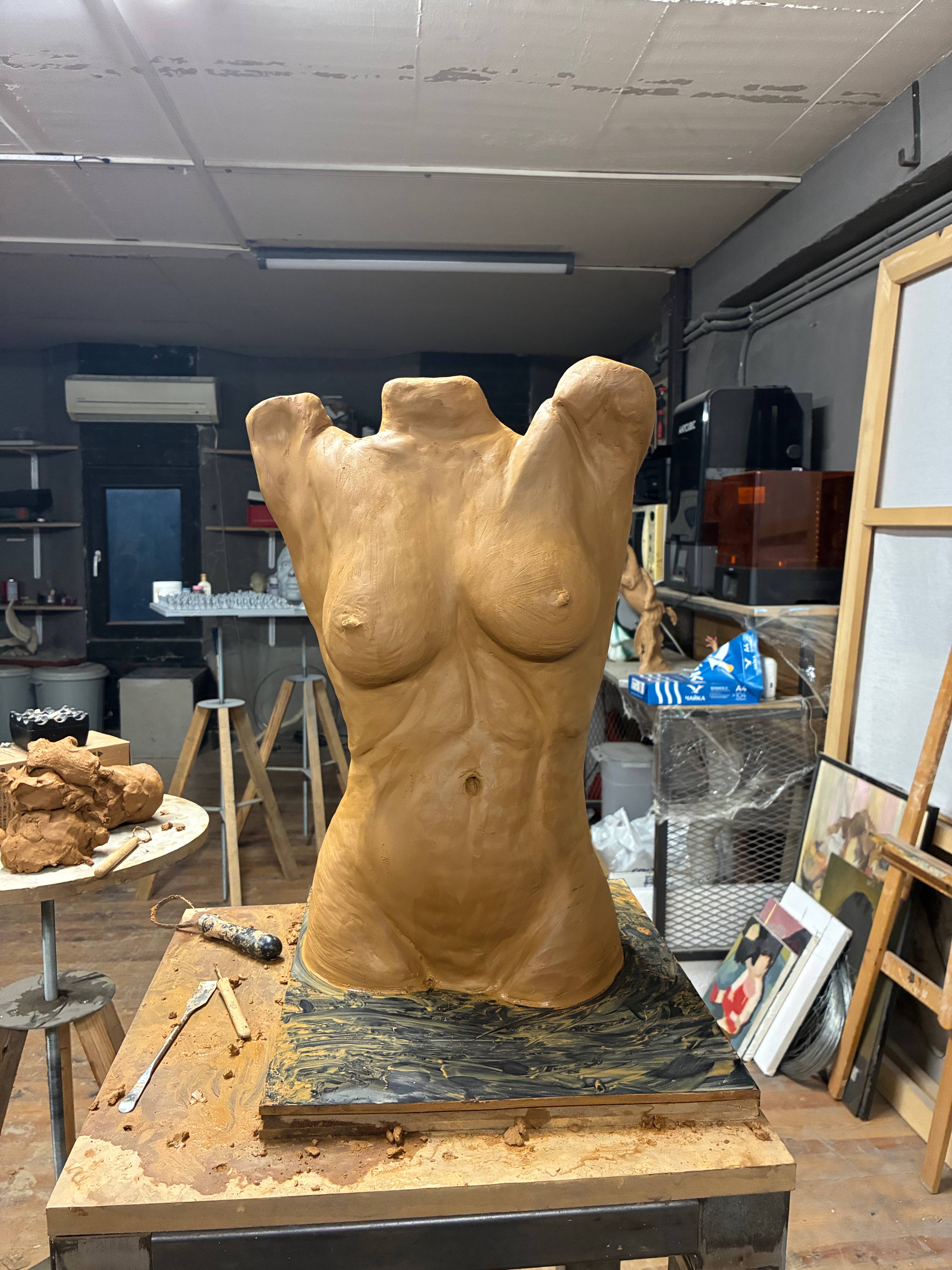
I spent ~10 hours in the studio working on the female torso. It’s not far from the finish. I also decided on the next two sculptures I want to make: a male arm holding a hammer and a full-size female leg. After these two I’ll allow myself to graduate from human anatomy and work on more abstract things.
We watched Die My Love (2025). I’m adding it to the list of movies that provide a glimpse of the feminine psyche. I found a lot of parallels between Grace’s turmoil due to her creative block and my own relationship with creativity. I might want to explore this further in a future blog post.
I don’t know why but on a whim I decided to create a personal Instagram account and connect with my friends there. I think something in me is trying to communicate an elevated need for connection.
Speaking of connection, after a discussion on the future of our zine, I started to feel a strong urge to create a digital publication to collectively publish something periodically. I think this too stems from the same impulse.
We saw a play called Fairfly which I really enjoyed. I wrote about it at length in another post.
Days feel like they are compressed lately. I don’t feel like I’m attending life that seriously. This is not an unfamiliar feeling, to be honest. When this happens, I always find myself saying: “I know days are passing but I don’t know if the time is progressing.”
A few months ago, I mentioned that I’m giving audiobooks a chance. As of yesterday, I concluded the experiment and once more decided that audiobooks are not for me. Although the listening experience was enjoyable, I don’t have that much opportunity to wear headphones and listen to a book, and when I have the opportunity it’s usually for a brief period (10-15 mins), during which I usually prefer listening to something on YouTube. Because of this, the book I was listening to, The Time Regulation Institute, was waiting unattended even though I was enjoying it very much. I decided to continue reading it as an ebook.
In parallel, I continue reading The Shadow of the Torturer by Gene Wolfe. At first, I found it hard to read, mostly because of the author’s choice of words: a lot of medieval terms and words Wolfe invented himself (at least I assume so, because they have no definition in the dictionary). After grinding through 1/3 of the book, reading became easier. I think I started to get used to Severian.
On Thursday, I published my most popular post ever on this blog. It’s a wonderful feeling to see something I wrote resonate with others. Also, I noticed how different the attention of strangers makes me feel here compared to social media, especially Twitter. On Twitter, I had a few viral tweets (thousands of retweets and likes) in the past, and they always made me feel dirty, even ashamed of myself. Here, on the other hand, it made me feel connected.
We watched 28 Days Later (2002) this week. I’m not well versed in the history of zombie-apocalypse movies, but I thought this movie established a few tropes in the genre, the biggest being “in any apocalyptic setting the most horrid thing you will encounter is other humans”.
I created a group in the Critical Theory space on DFOS for people who want to talk about the philosophy of Slavoj Žižek. I don’t know if this will turn into something. I would love it if this place became somewhere Žižekians, Lacanians, Hegelians and Marxists could connect with each other and exchange ideas.
If you’re reading this, consider yourself invited.
The appeal of living in a small town is being surrounded by the right number of people whom you can care about. On the other hand, living in a big city might make you feel lonely in huge crowds.
Being a blogger in smallweb (or IndieWeb) is akin to living in a small town with one big exception: there’s no square in the middle of town, no town hall to gather around. In this sense maybe the proper analogy is a small island rather than a town. Smallweb can easily be an isolated experience.
Contrary to the corporate platforms where the connection is heavily mediated to be commodified, in smallweb the connection needs to be intentional. Connection here requires quilting points even if temporary.
I feel a recent change in the smallweb. It’s started to feel more connected than ever. Take Robert’s Junited for example: this year’s participants outnumber those of all previous years combined. I believe the reason for this liveliness is the emergence of blog directories and discovery platforms that act like quilting points for shared meaning. How would I have participated in junited if I hadn’t heard about it in the first place?
Bubbles is one example of a gathering location for the smallweb. It’s a blog aggregator where you can discover the newest posts published on a handful (~5000) blogs. Kagi smallweb is another one with a different approach. Bear Blog’s discover page is another one; although it’s platform-specific, it’s part of the smallweb in spirit. A recent addition is the standard.site protocol where stitching blogs together happens automatically thanks to AT Protocol. They are gravity points that halt the centrifugal drift of isolated blogs in the smallweb. Together, they create a landscape for shared discourse.
These developments are signs of the upcoming smallweb renaissance. Smallweb no longer feels like a refugee camp where people find themselves thrown together while escaping the high walls of the corporate web. We are now building something together. Our isolated islands have started to feel like an archipelago.
I do strength training with a personal trainer 3-4 times a week. Almost every time I’m a few minutes late and I always inform him that I’ll be late. He says I’m so traditionally late that I don’t even need to mention it. I guess the same applies to my weekly updates.
I was in the studio twice last week (including today) working on my new sculpture. Today was one of those days where I made negative progress :(
We watched Lee Cronin’s The Mummy. I was hoping for a scary movie but it was only disgusting. Where are those really scary movies?
I started reading The Shadow of the Torturer by Gene Wolfe. It’s been a while since I started reading a new fantasy series.
Last Wednesday we held a memorial for the death anniversary of the great Turkish poet, Nazım Hikmet Ran. It was a day of poems and songs. Many people read his poems I know, but there was one poem I’ve never heard of where Nazım (Turkish) walked over Berkeley and his idealism.