halloy.chat might be the prettiest software i’ve seen
in a long time!
i forgot to mention the whereabouts of the photos i talked about in
january. i decided to buy yet another
domain and create a new site. this way i have the liberty of posting photos
without worrying about their “professional” associations. my photoroll is now
live on hyperimages.net.
i smoked weed tonight (ofc i did–i am in amsterdam) after 6 months of cold
turkey. i both missed the feeling of my intuition firing on all cylinders and
forgot how much work it was to flow with it. thankfully, my years of reading
posts on r/petioles about tolerance breaks finally resulted in something and i
started with a low dosage. btw the appeal of amsterdam is not weed being
“legal”, it’s a city that offers you hundreds of AMAZING spots to sit and
smoke. (i wish i had taken the photo of the benches at my metro station’s
exit).
nothing much happened last week due to my hours in front of the keyboard. it
was a busy week at work–i needed to create a PoC for point-in-time recovery
for mysql on kubernetes. i’m writing a post about it for
ege.dev, hopefully will publish it sometime this week.
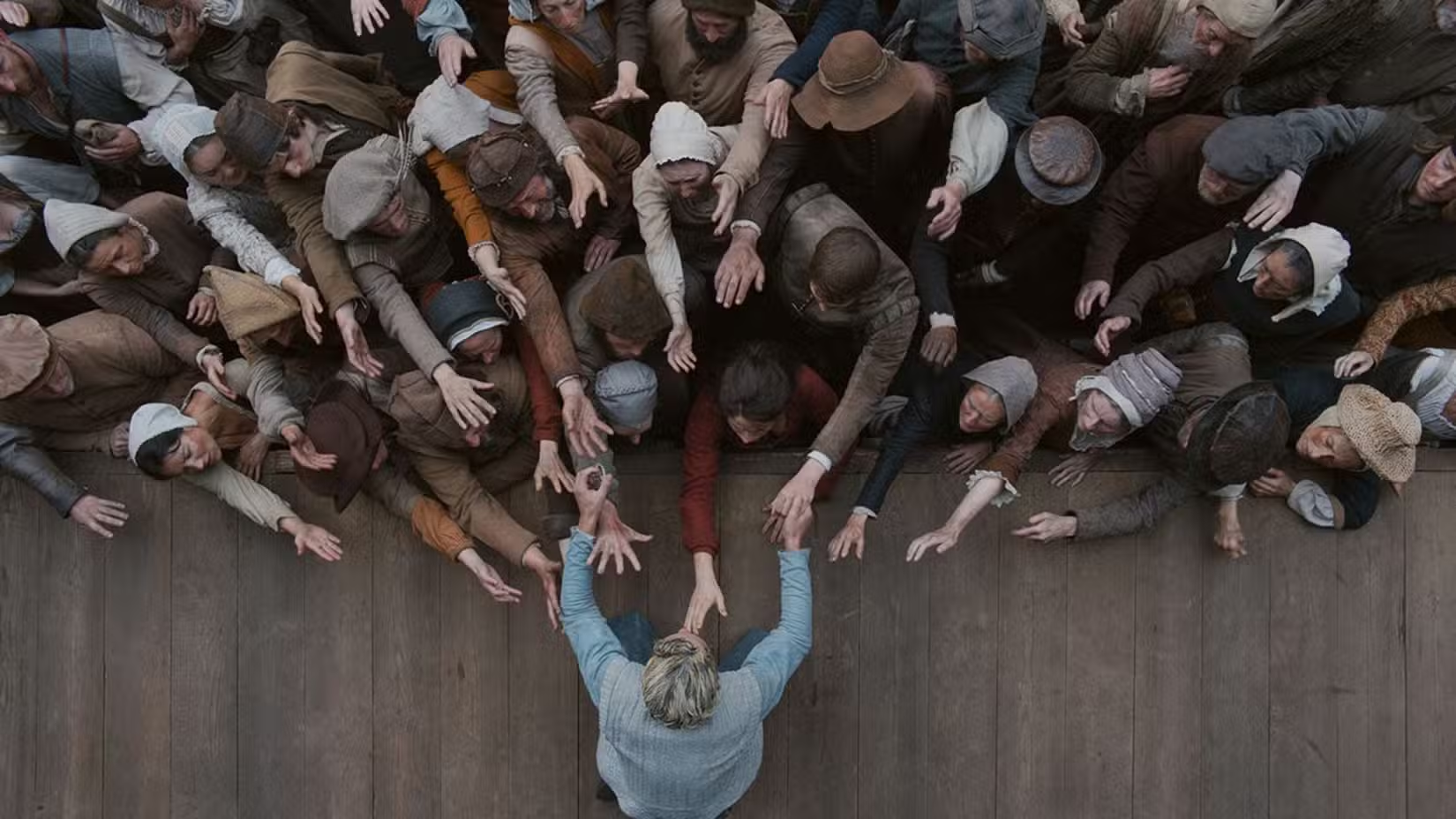
We were watching Pluribus for the last 10 days and finished the first season
today. I have mixed feelings about the show. I especially found the first few
episodes hard to watch because I couldn’t stand Carol. It got easier towards
the end of the season but I can’t say that I loved the show. Nevertheless, it
was an interesting watch. I especially liked the depiction of the collective
power that humans possess. It’s eerie to think about the connection between our
individuality and the problem of coordinating with others. I read a
take
(Turkish) that said the show is trying to teach communism to American masses
but I disagree. Although the world becomes communist in a few hours after
everyone gets “infected,” Pluribus’ virus is not of communism but McLuhan’s. It
turns the world into the global village:
Global village is not created by the motor car or even by the airplane. It’s
created by instant electronic information movement. The global village is at
once as wide as the planet and as small as a little town where everybody is
maliciously engaged and poking his nose into everybody else’s business. The
global village is a world in which you don’t necessarily have harmony. You
have extreme concern with everybody else’s business. And much involvement in
everybody else’s life. — Marshall McLuhan
The global village, once formed, renders game theory useless. And thus, it
removes the hardest problem of communism: the coordination. In this sense, I
found Pluribus deeply anti-communist. Communism is shown as only possible in
the case of an alien hive mind with a biological imperative to cooperate. The
obverse, of course, is that we, as humans, have a biological imperative that is
not suitable for communism.
Kagi Small Web
It’s been a few weeks since I started using kagi as my
search engine. I love this kind of initiative that tries to form a more humane
internet (I believe we need to
reclaim the internet). Apart from my
RSS reader, Kagi Small Web has become my go-to to
read stuff on the internet. To my pleasure, they also released it as a mobile
app last week!
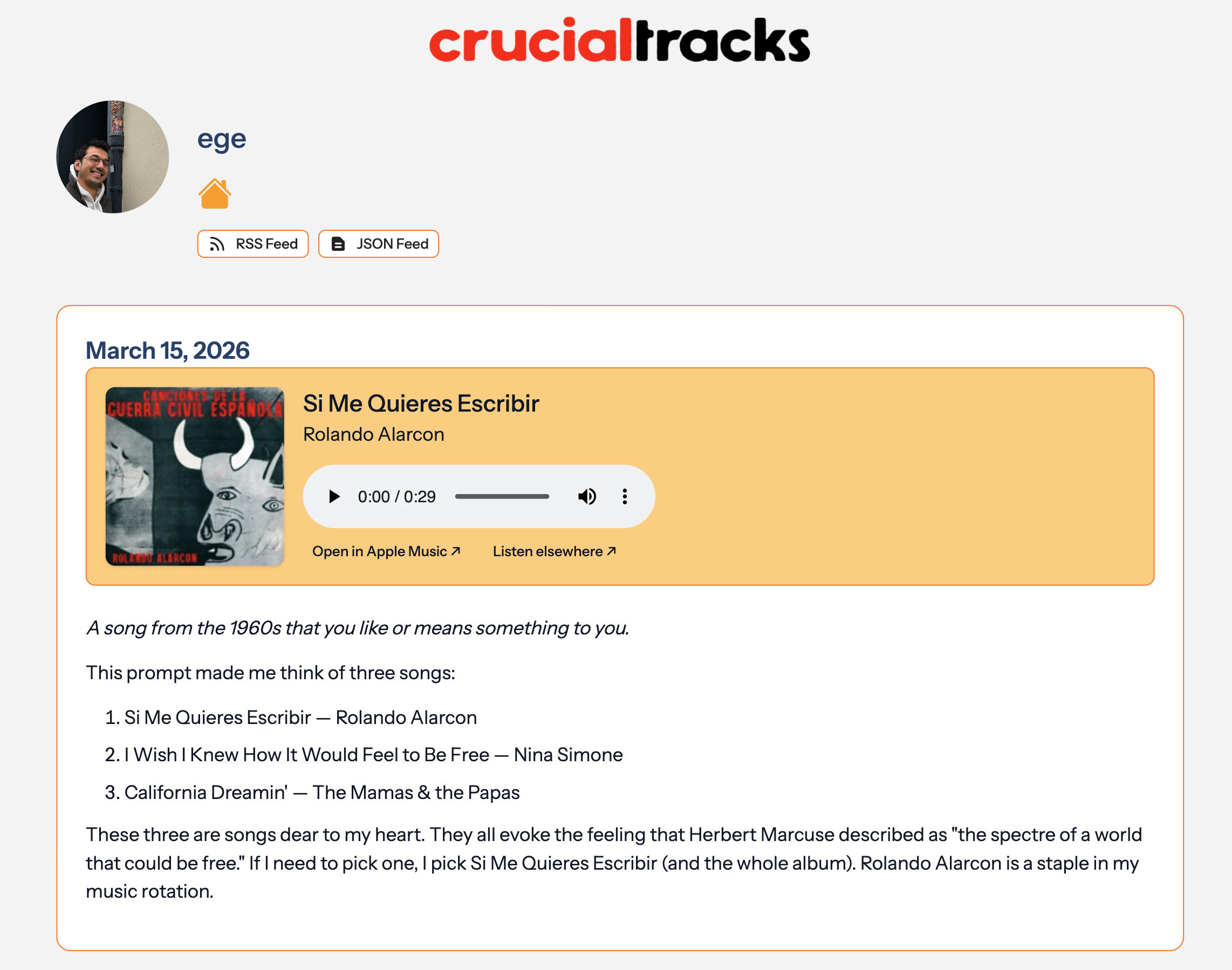
Crucial Tracks
What are crucial tracks? A crucial track is a song that changes the direction
of your life or helps you see the world in a different way. The songs that
represent relationships or trigger memories. The songs that make you, you.
Crucial Tracks is a music journal with a simple idea: share the important
songs in your life. Every member gets one post per calendar day. Use a daily
prompt or pick any subject you’d like!
You can subscribe to my feed
with your favorite RSS reader.
I wish I could share all the love that’s in my heart Remove all the bars that keep us apart I wish you could know what it means to be me Then you’d see and agree That every man should be free (I Wish I Knew How It Would Feel to Be Free)
2026 is definitely the year of blogging for me. I already published twice as many posts as I did last year. Last Friday I published a post in my technical blog in the same vein as this post: a reflection on the week. Today I posted another one there about the women who shaped me in my career. Happy Women’s Day to all women around the world!
I’m writing this while my neighborhood is under siege by law enforcement. There’s a bunch of police officers in every corner just because the women of Istanbul want to have a rally to celebrate March 8, express their anger and mourn the losses of their fellow sisters who were killed by men.
As politics affects citizens of privileged countries more and more, I see more people writing about it on their personal corner of cyberspace. But for some reason it always comes with an apology for bringing up political issues. That’s the primary reason why we feel powerless in the face of the political crisis we are currently in: political space is treated as something separate and political issues as something you should almost feel ashamed for caring about. The collective person is forgotten in the pages of history. What we have now is a radically atomized individual who can only relate to others by their choice of commodities and lifestyle.
In order for me to write poetry that isn’t political I must listen to the birds and in order to hear the birds the warplanes must be silent.
This was a really busy week. I worked more than 8 full-focus hours every
single weekday. This means I probably spent more than 10 hours in front of the
computer. It’s a lot! Thankfully this week was a 4-day week so I had time to
rest.
On Friday I spent the whole day working on my sculpture. The bust is coming
along. I decided to do something strange (as I usually do) and make it half
female and half male. I don’t know how I will do the transition smoothly in the
middle of the face but we’ll see.
The biggest thing this week was seeing Louis C.K., my favorite comedian, live
in Istanbul. It was amazing. He’s the king of uncomfortable topics and no one
does body horror like him. Seeing him live was an incredible experience, I feel
very lucky to have had the chance.
I tried to see Louis before, in 2022. He was going to do a show in Kyiv on
February 25. I bought tickets and went to Ukraine. On February 24, the war
started. Yes, I was in Ukraine at the time (maybe I will write that story here
some day). A day before the Istanbul show, I jokingly said that USA is going to
attack Iran on the day of the show. My friend laughed at me for believing such
superstitious shit. On Saturday morning he sent me the news about Israel’s
bombing of Tehran. I told you so!
It didn’t affect the show though and I managed to see Louis this time. Writing
this makes me a bit ashamed of myself. People’s homes are bombed and I am
grateful because it didn’t affect my Saturday evening plans. My father used to
say that we are like antelopes. Our fellows are mauled to death right in the
corner and we keep chewing the grass until it’s our turn.
I wrote about the upcoming war at the
beginning of this year. I don’t know at which point history books will start
the third great war in the future—or whether there will be history books or
humans to read them—but it’s happening right now. It’s crazy how contingent
everything is. The world is in the middle of a political crisis on top of the
economic one. But in the end, we are heading to this war because of a handful
of people’s personal agendas—Netanyahu’s imperialist ambitions and Trump’s need
to get away from Epstein. Busy, busy, busy.1
A few hours before writing these lines, we watched Sinners (2025). I
really enjoyed it but I don’t see why it has record-breaking number of Oscar
nominations. It definitely didn’t feel that groundbreaking to me. Nevertheless,
the racial tensions were perfectly portrayed. And the music… I am writing
this while listening to the soundtrack. The scene where Sammie sings “I Lied
to You” deserves an Oscar.
Ah, also I wrote The Designated Rebel this
week. It had been sitting on my backlog for a long time. I don’t think I did a
good job writing it but I am happy that I did it anyway. Someday I’ll revisit
it and do it the justice it deserves.
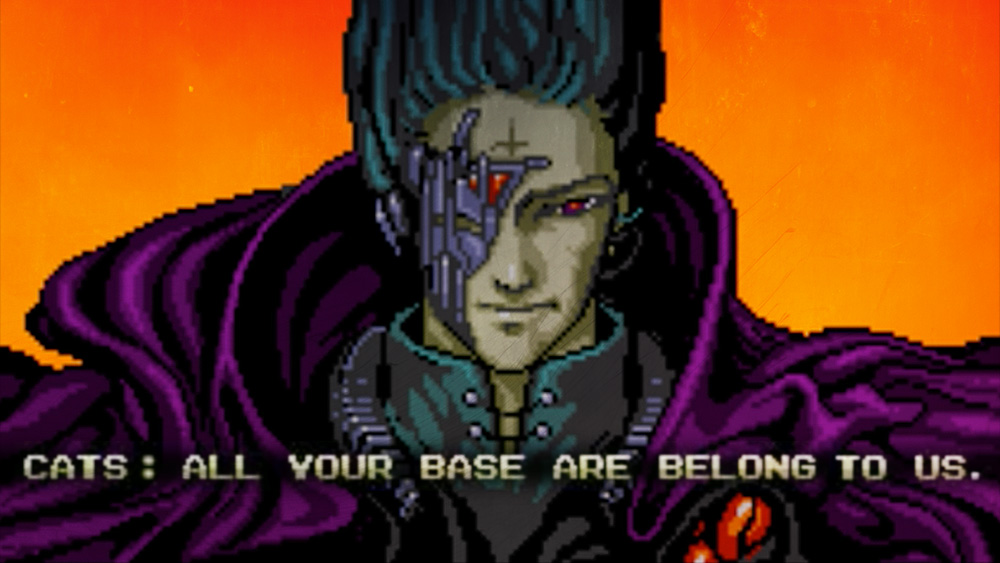
I didn’t like Cat’s Cradle much when I read it but it’s crazy how
much I think about it. I wonder if I have any other examples of something like this. ↩︎
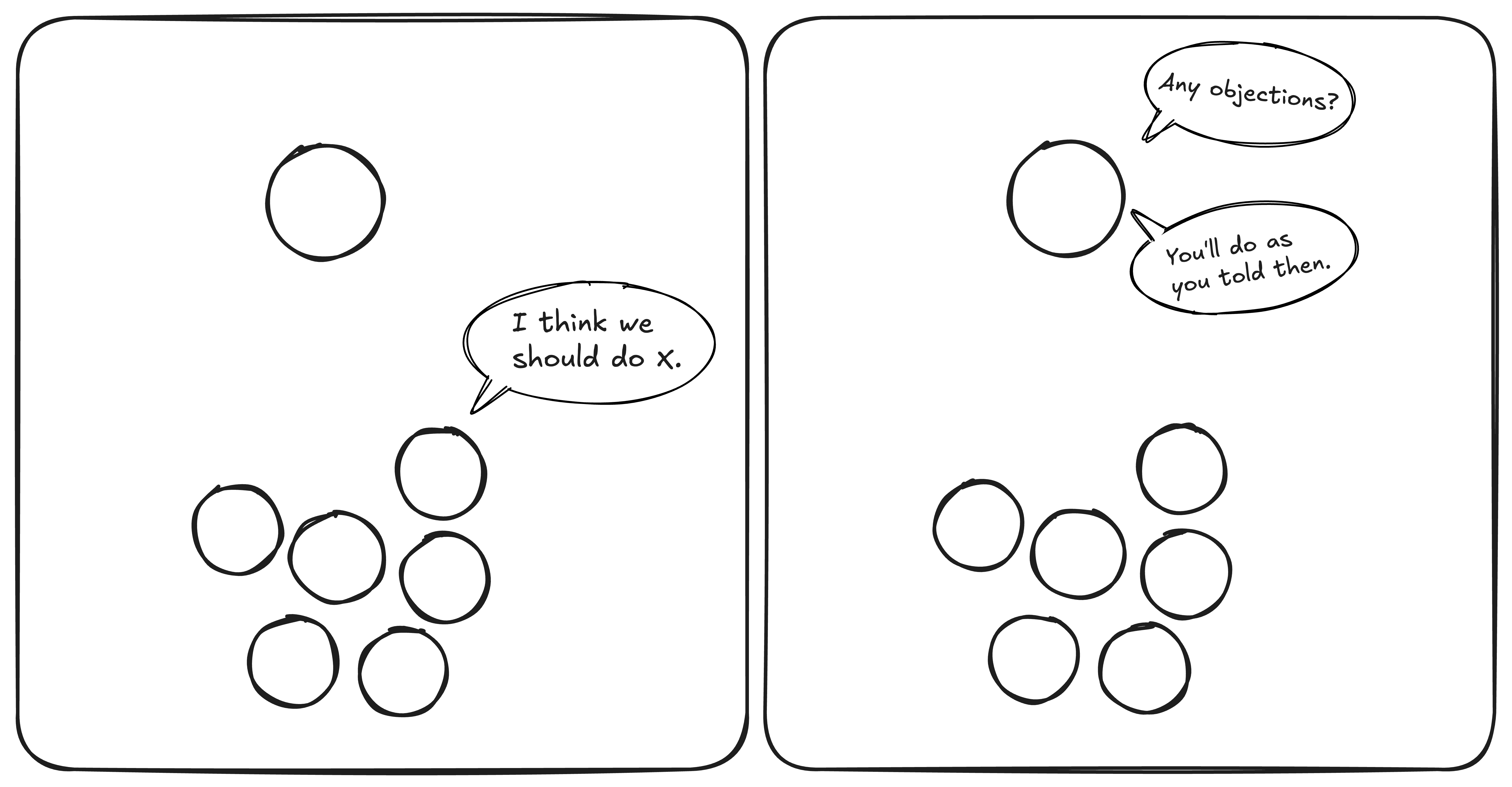
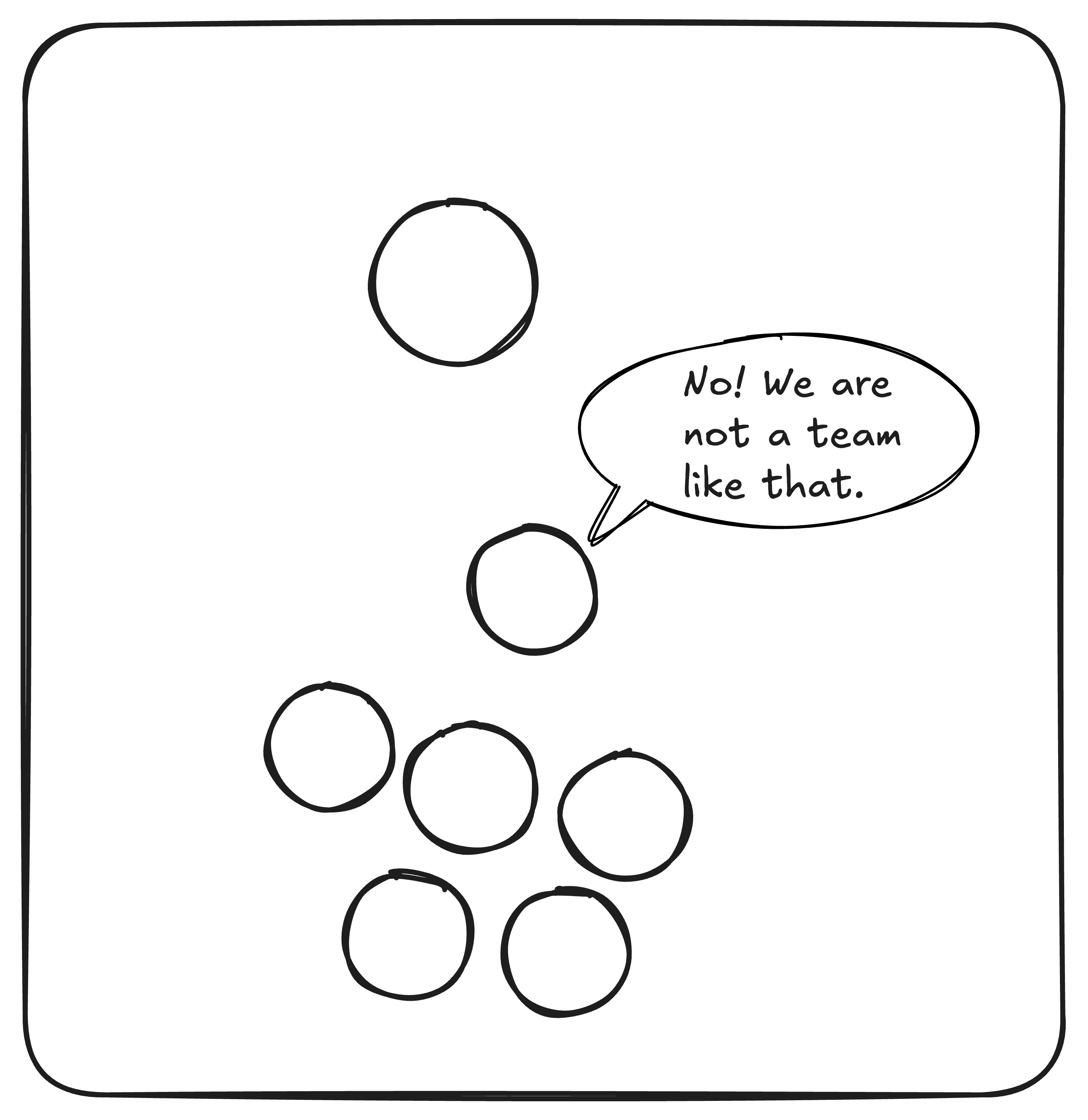
A while ago, during a sprint retrospective, I suggested significant changes to
our “Definition of Done.” When I finished, the room went quiet. What did that
silence mean?
The silence lasted nearly a minute. Why was no one saying anything? Finally,
the PM broke the tension by prompting the team:
His comment further irritated me. I wondered: Are we really going to operate
like this, where I suggest a top-down change and everyone silently accepts the
new rules? So, I protested.
After the meeting, I couldn’t stop reflecting on it. A quote from Žižek began
racing through my mind: “Those in power often prefer even a critical
participation to silence.” I told myself I spoke up to allow people to be
active participants in decisions affecting their day-to-day lives. But then I
had to ask: Did I say what I said because I was in a position of power?
At the moment, I thought the PM was interpreting the silence as agreement and
that his comment was calcifying the team’s passivity. Later, I realized the
opposite was true. He was the one trying to break their stagnation; his joke
was the perfect bait. It was an invitation for the team to engage.
This led me to a sad realization: my objection achieved the exact opposite of
what I intended. It only made everyone more comfortable in their passivity. By
jumping in to “defend” their right to speak, I became the Designated Rebel. I
allowed them to stay passive while feeling good about having a champion. Now
they know someone will always speak up “for” them. I had become part of the
very power structure I was trying to resist.
So, did I speak up because I was in a position of power? Was I trying to keep
the team busy with “pseudo-activities” so that nothing changes while a lot is
happening?
Modern politics often functions this way. There is an ever-present urge to be
active and to participate. We tweet, we condemn, and we protest—all within the
coordinates of the system. We do a lot so that, ultimately, nothing really
changes. Our critical participation is exactly what allows the system to
function.The best example of this is Žižek’s neurotic, who endlessly talks on
the divan because a moment of silence might result in the analyst asking a
crucial question.
While the passivity of subjects might give them breathing space to see the
underlying mechanism behind politics, in a space where decisions are made from
the bottom up, it simply locks everything down. If people refuse to participate
in a democratic space, there is no moving forward.
Contemporary democracy is often an illusion to obscure the fact that a minority
rules over an enormous majority. In that context, whatever keeps us busy
enough—discourse, work, pleasures—to avoid revolting is “good” for the system.
However, in a team that runs on democratic principles, decisions require
participation. Without the critical engagement of my teammates, whatever I
suggest is impossible to truly implement. My “power” over them is only the
influence I’ve earned—or perhaps I am in power and completely blinded by the
fact that my “rebellion” is just the grease on the wheels of their silence.
This is the 8th week since I created hypersubject.net. The effects of this experiment are already tangible. Compared to last year, I have already spent twice as many hours working on my blog(s) and nearly half that time writing even though we are only two months into 2026. I have already published 12 posts this year, which is far more than my total output for all of 2025.
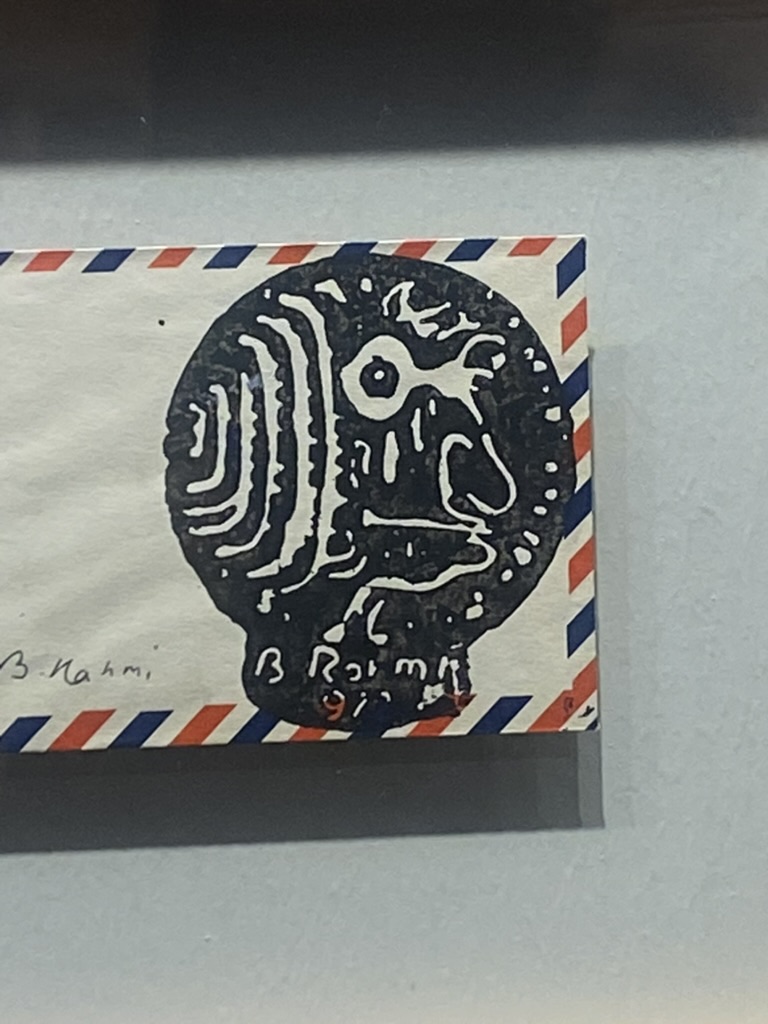
Two weeks ago, I decided to write a blog post every day. Unfortunately, it didn’t work out. It’s better to focus on what I can accomplish rather than beating myself up for things I simply cannot. This week, I visited an exhibition of Bedri Rahmi Eyüboğlu’s drawings on the envelopes of his letters. In one of the letters, he writes about how writing letters is difficult and requires one to find an opportune time for it. It’s exactly the same for blog posts; they demand their own time and space to emerge.
Bedri Rahmi Eyüboğlu, Autoportrait on envelope
My wife and I started watching The Museum of Innocence, a miniseries based on Orhan Pamuk’s novel. When she first suggested it, my initial reaction was negative—I have a natural aversion to anything popular. But I caved, and I’m glad I did. This might be one of the best things I’ve watched in my native language. And the directing… Zeynep Günay is doing something magical. In many scenes, I thought, “Where has this level of directing been in other Turkish works?” I haven’t read the novel, but I am certain the director’s female perspective has only elevated the story. One could talk about obsession, repetition, and the objet petit a for hours. I would, if I were Žižek—but I am not.
Speaking of the female perspective on the silver screen, this week I watched Hamnet, directed by Chloé Zhao. It’s easily the best movie I’ve seen recently. I don’t think it’s enough to say the movie is feminine; I would say the movie is a woman1. It tells the story of William Shakespeare by telling the story of his wife, Agnes Hathaway. If I could describe the feelings the movie awakened in me, I would be a candidate to put my name right up there with Shakespeare himself.
It was impossible to hold back tears in this scene.
Portrait of a Lady on Fire, written and directed by Céline Sciamma, was also like this. ↩︎
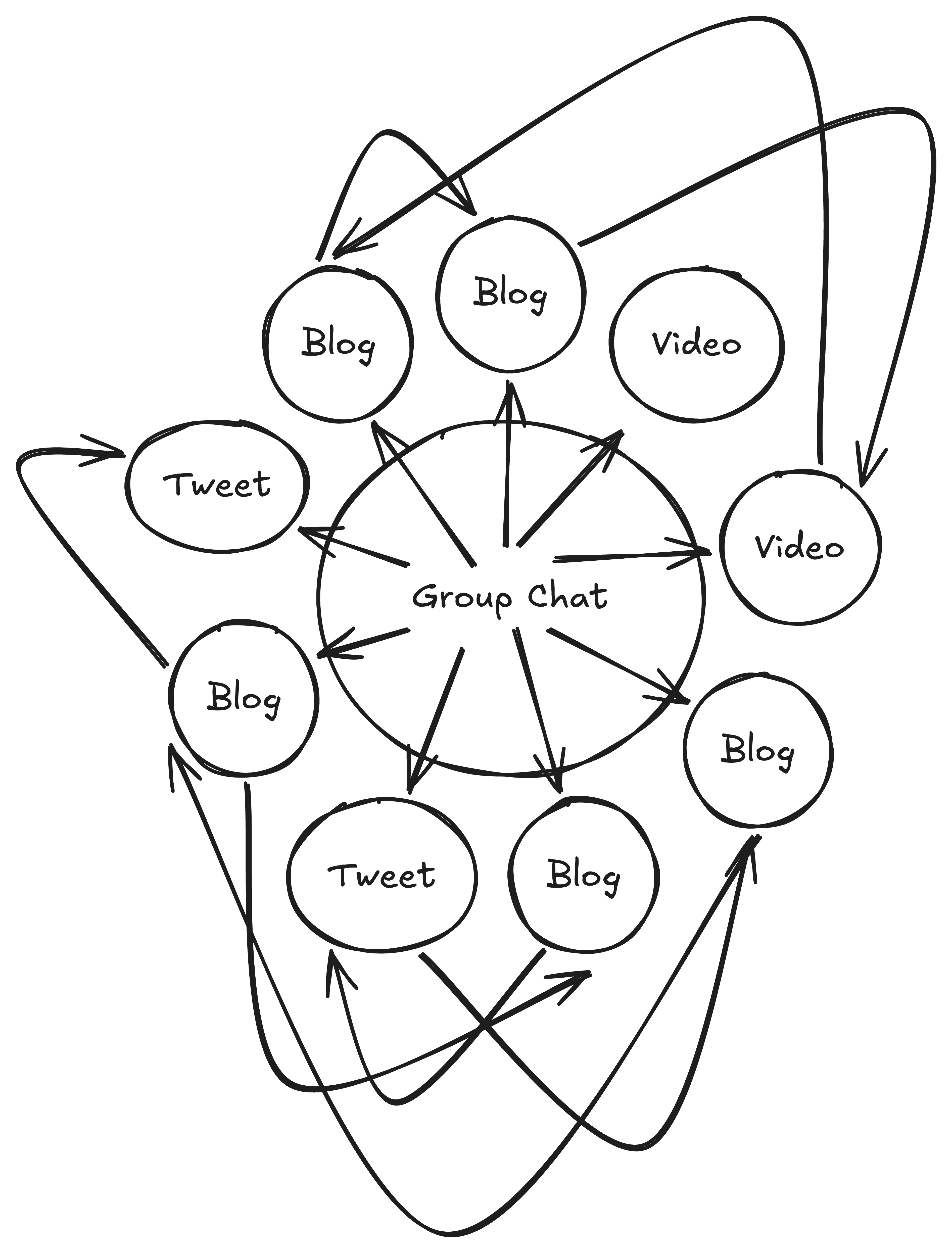
I find myself once again yearning for a digital community. I believe the future of social media (for me) is some kind of invite-only group chat where the conversation flows like a river. It might live in Discord, Slack or even IRC, I don’t care1. Physical community is important but as a millennial I need text-based friendships too.
On Friday, I got a message from kerey on WhatsApp saying that “there is a need for a non-normie consortium”. It triggered a long conversation about the normie/non-normie dichotomy and whether this type of distinction is elitist or not. I collected my thoughts on this in Against the Non-Normie.
This type of interactions is at the heart of my ideal community. An off-hand remark starts a discussion where we argue and develop the idea and in the end this turns into some kind of writing. Then this writing gets responses from other members in the community in a variety of forms. A community that perpetually creates discourse for discourse’s sake.
This is not something that I might just land on. This type of community requires someone to build it from the ground up. “Somebody has to, and no one else will.”
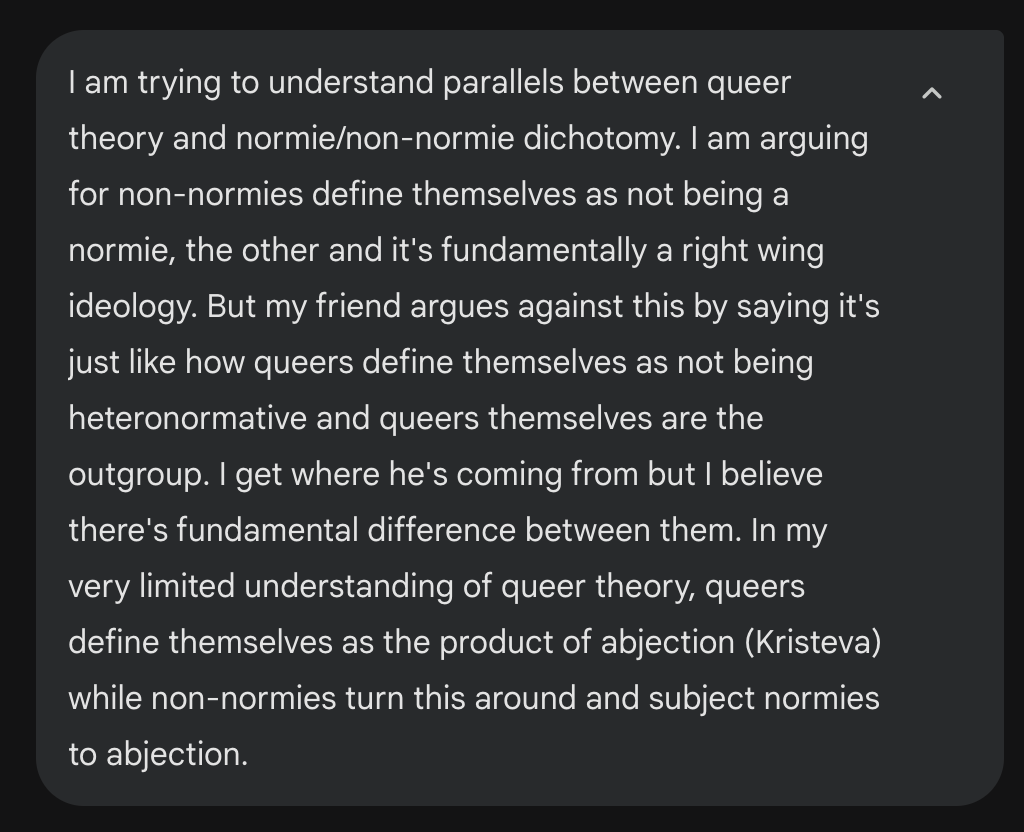
Speaking of Against the Non-Normie, I feel a bit uncomfortable about that piece. I believe what I said there but I feel uneasy because of the process I wrote it with. During our conversation, kerey raised the similarity between non-normies and queer community. Since gender studies and queer theory are not my forte, I asked Gemini to make the connection:
So I used AI. This might be an acceptable use of AI but I also copied two sentences from its output:
“The ’normal’ (heteronormative) subject only exists because it has successfully ‘cast out’ (abjected) anything that threatens its boundaries.”
“Reclaiming ‘Queer’ is an act of strategic essentialism; it’s taking the site of your own exclusion and turning it into a fortress for survival.”
These are not things I couldn’t write myself but they were just sitting there for me to copy them. But the fact that I copied them verbatim into my post makes me feel ashamed. I don’t believe this stains the whole post and makes it slop though. Maybe I think too black-and-white about the AI problem. This will be a problem I will need to navigate in the near future.
My preference would be an IRC server to scratch my hacker itch, but it’s hard enough to make people join a Slack workspace. ↩︎
“Normie” is a volatile term. Depending on the context, it might refer to atheists, New Agers, people who watch Netflix, people who don’t do drugs, conservatives, liberals, people who care about politics, people who don’t care about politics, people who are optimistic about the future, people who are pessimistic about the future, people who read only fiction, people who don’t read at all, people who read Kant, people who enjoy dancing in the club, people who don’t enjoy dancing, or people who are monogamous. In the end, “normie” is a signifier that points to the outgroup.
If something is in, it means something is out. The outgroup plays a constitutive role for the ingroup identity. The ingroup stabilizes its identity through outgroup. In this sense, normies are needed for non-normies to be able to define themselves.
Does this sound like queer theory? If you define the queer as someone who can’t be confined in heteronormative terms, then non-normies are intellectual queers? On the surface level it seems like this claim has a point. Queers and non-normies really look alike from afar. They both define themselves against a center and use transgression as a tool. You need to look close to tell the difference.
The “normal” (heteronormative) subject only exists because it has successfully “cast out” (abjected) anything that threatens its boundaries. The queer person is the excess, the waste that is refused by the system. Reclaiming “Queer” is an act of strategic essentialism; it’s taking the site of your own exclusion and turning it into a fortress for survival.
Is it possible to say the same for the “non-normie”? Does that identity begin with the experience of being the object of the system’s disgust? No, non-normie doesn’t claim to be cast out. They claim to be superior to the system. In their case, the direction of abjection is flipped: by labelling others as “normies” or “NPCs,” they are the ones performing the act of abjection. They cast the “normal human” out as something less-than-human—mindless, soulless, rule-following automata.
Contrary to the bottom-up identity of “queer”, non-normie is a top-down and elitist exclusion. It follows the familiar script of right-wing hierarchies, where the world is divided into an enlightened ingroup and a mindless, discardable mass. “Non-normie” ideology believes in a natural and immutable hierarchy between people. Non-normie doesn’t want a more inclusive world; they want a world where NPCs recognize their own inferiority.
Just finished another session of psychoanalysis. Analysis is by far the thing I least enjoy every week. I mean, it works, at least for me, but it’s definitely not something I look forward to. Because it demands me to say the Thing.
What’s the Thing? No one knows. Is there even a Thing? Probably not. But its non-existence doesn’t mean that it has no effects. Structurally, the analyst occupies the position that demands you to say the Thing. How you react to this feeling is the basis of the analytical relationship between you, the analysand, and the analyst.
I’ve spent entire sessions speaking to fill the air. I made sounds with my tongue and mouth which were somehow intelligible to the analyst, but they didn’t have any substance in them. I spoke just to get through the session. What I said didn’t go anywhere, didn’t unfold into anything, didn’t resurface something forgotten. The worst part is I said them knowing I was not saying anything important.
Sometimes I managed to say something. It was not the Thing, of course, but wrestling with the impossibility of saying the Thing made me say something important. I usually don’t know that I’ll say something substantial until words come out of my mouth. I love those moments. How can I have these kinds of moments more, rather than the hollow talk above? I don’t know.
But there’s one thing I am sure of: Hollow sessions aren’t wasted time. Without the frustration of that hollowness, I never would have said anything. There are “one shot, one opportunity” moments in life where you really ought to say something, and those moments come to those who are in the game.